FDA Grants Full Approval to Tecartus for Relapsed Mantle Cell Lymphoma. Here Is What That Means for Biotech Operators.
On April 3, 2026, the FDA converted Tecartus from accelerated to full approval for adult patients with relapsed or refractory mantle cell lymphoma (MCL). For CAR-T commercial teams, market access functions, and specialty operations leaders, this is not a formality. Full approval changes the commercial game in ways that accelerated approval never could.
What Happened
The FDA granted traditional approval to brexucabtagene autoleucel, known as Tecartus, developed by Kite Pharma, a Gilead company. The decision was based on data from cohort 3 of the ZUMA-2 study, which evaluated the therapy in BTK inhibitor-naive patients who had received up to five prior lines of therapy (ASCO Post, April 3, 2026).
The numbers are compelling. Cohort 3 showed a 91% objective response rate and a 79% complete remission rate in BTK-naive patients. In cohort 1, which covered BTK-inhibitor experienced patients, the response rate was 87% with a 62% complete remission rate. In both cohorts, the median duration of response was not reached. The full approval now incorporates pooled safety data from all three cohorts across 168 patients.
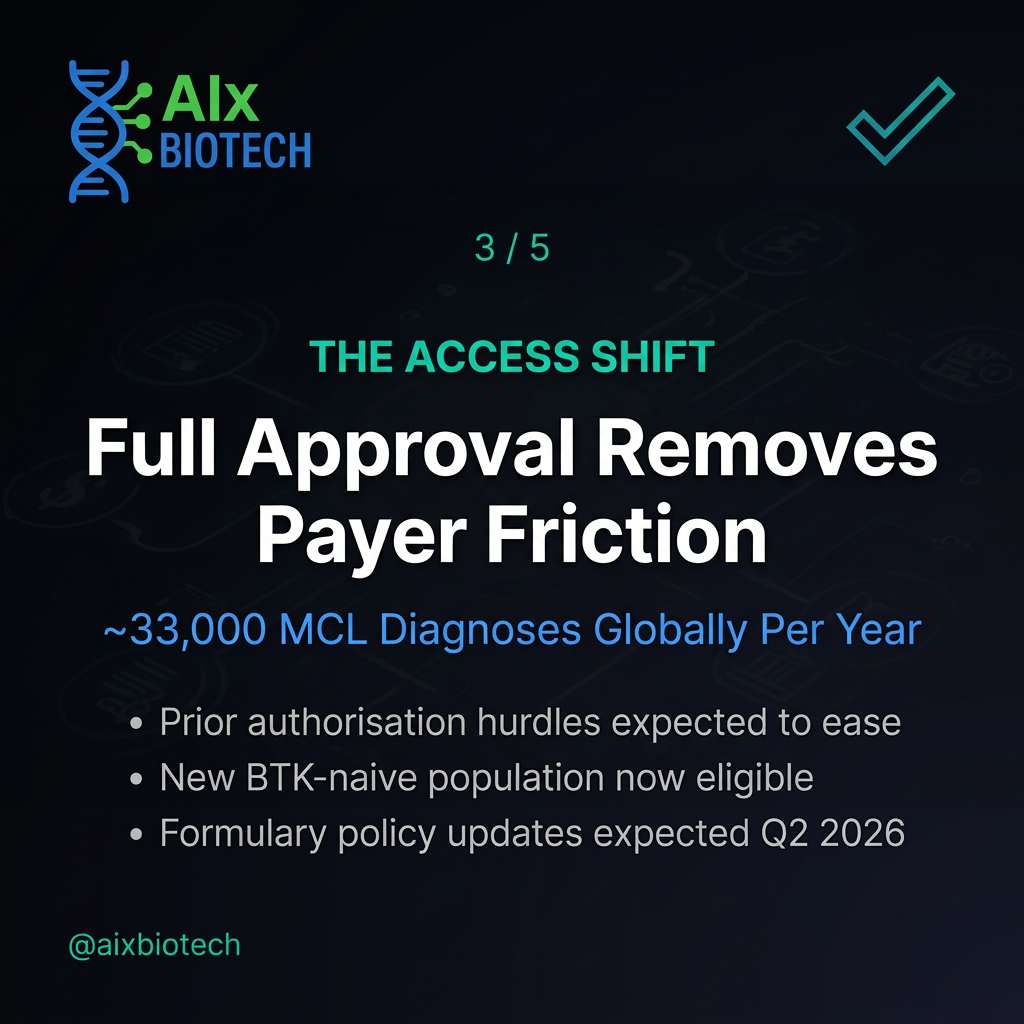
MCL is a rare and aggressive form of non-Hodgkin lymphoma. Approximately 33,000 people are diagnosed with it globally each year. Following relapse, the disease moves fast. Treatment options are limited. This full approval gives clinicians and payers a confirmed, durable option backed by long-term trial evidence rather than early surrogate endpoints.

Why It Matters for Biotech Operators
- Full approval removes payer hesitation. Accelerated approval creates reimbursement friction. Payers hedge on formulary placement and prior authorisation requirements when a therapy is still under post-marketing confirmation. Full approval eliminates that ambiguity. Expect faster access decisions and reduced administrative burden for treatment centres.
- The BTK-naive label expansion is commercially significant. Cohort 3 data opens a new patient population that was previously outside the indicated use. This is not just a label update. It is a market expansion that commercial teams need to plan for now in terms of field targeting, account prioritisation, and KOL messaging.
- CAR-T supply chain pressure increases with demand. Full approval typically drives volume increases. For a therapy that requires individualised manufacturing, leukapheresis scheduling, and vein-to-vein turnaround times, every incremental patient adds supply chain complexity. Operations teams should reassess capacity planning and site readiness in authorised treatment centres.
- Safety profile requires field force preparation. The updated prescribing information pools safety data across 168 patients. CRS occurred in 93% of patients. Grade 3 or higher neurological events occurred in 33%. Commercial and medical affairs teams need to ensure treatment centres have updated risk management protocols before new patient cohorts ramp up.
- Competitive intelligence benchmark is reset. This approval sets a new efficacy standard for CAR-T in MCL. Any competing programme in this indication now needs to explain how it differentiates from a 91% response rate with durable remissions.
What to Watch Next
The immediate commercial test is how quickly payers update formulary coverage to reflect full approval status. Market access teams at Kite and at competing haematology companies should track payer policy updates across major US commercial insurers and Medicare Advantage plans through Q2 2026. International regulatory submissions in Europe and Asia will follow, with EMA and PMDA reviews likely prioritised given the strength of the ZUMA-2 data package.
The broader signal for the industry is that the accelerated-to-full approval conversion pathway is working. This puts pressure on every CAR-T and cell therapy programme still operating under accelerated approval to deliver confirmatory data on schedule. Delays now carry commercial consequences, not just regulatory ones.
For operations leaders, the question is capacity. CAR-T manufacturing is not infinitely scalable. As covered in the analysis of how AI is compressing every layer of biotech simultaneously, manufacturing timelines and commercial windows are both shortening. AI-driven demand planning and site readiness tools are no longer optional for CAR-T programmes operating at this scale.
From a valuation and investment standpoint, this approval reinforces confidence in Gilead’s oncology pipeline and demonstrates the commercial viability of the Kite acquisition. As explored in why traditional biotech valuation models are no longer enough, durable remission data with no median reached on duration of response is exactly the kind of endpoint that forces a revaluation of peak sales projections across competing assets.
Key Takeaway
91% response rate. Full approval. 33,000 patients per year. Tecartus just became the gold standard in relapsed MCL. If you are in CAR-T operations, market access, or competitive intelligence, your planning assumptions changed on April 3.