AI in Specialty Drug Demand Forecasting: From Missed Targets to Measurable Results
AI in specialty drug demand forecasting is solving one of the most expensive problems in biotech commercial operations. Half of all pharma launches missed their first-year sales targets in 2023, according to industry analysis. For specialty drugs, the failure rate is even higher. Traditional models were not built for small patient populations, concentrated prescribing, and payer-driven demand volatility.
AI changes the equation. Not as a concept. As a working system with documented, verifiable results.
- Up to 55% reduction in monthly inventory costs
- Up to 75% fewer stockouts
- 80%+ forecast accuracy at a 6-month horizon
- 80% reduction in time spent building forecasts
AI in Specialty Drug Forecasting: What Is Changing in 2025
The gap between what commercial teams need and what traditional forecasting delivers has become impossible to ignore.
Specialty drugs operate in conditions that break every assumption a standard model relies on. Small patient populations. Prescribing concentrated among a handful of specialist centers. Reimbursement decisions that shift demand overnight. Cold chain and dosing complexity that adds variability at every stage of the supply chain.
Traditional methods rely on historical sell-in data, spreadsheets, and the judgment of the person in charge. When markets are stable and volumes are high, that works. In specialty, it fails consistently.
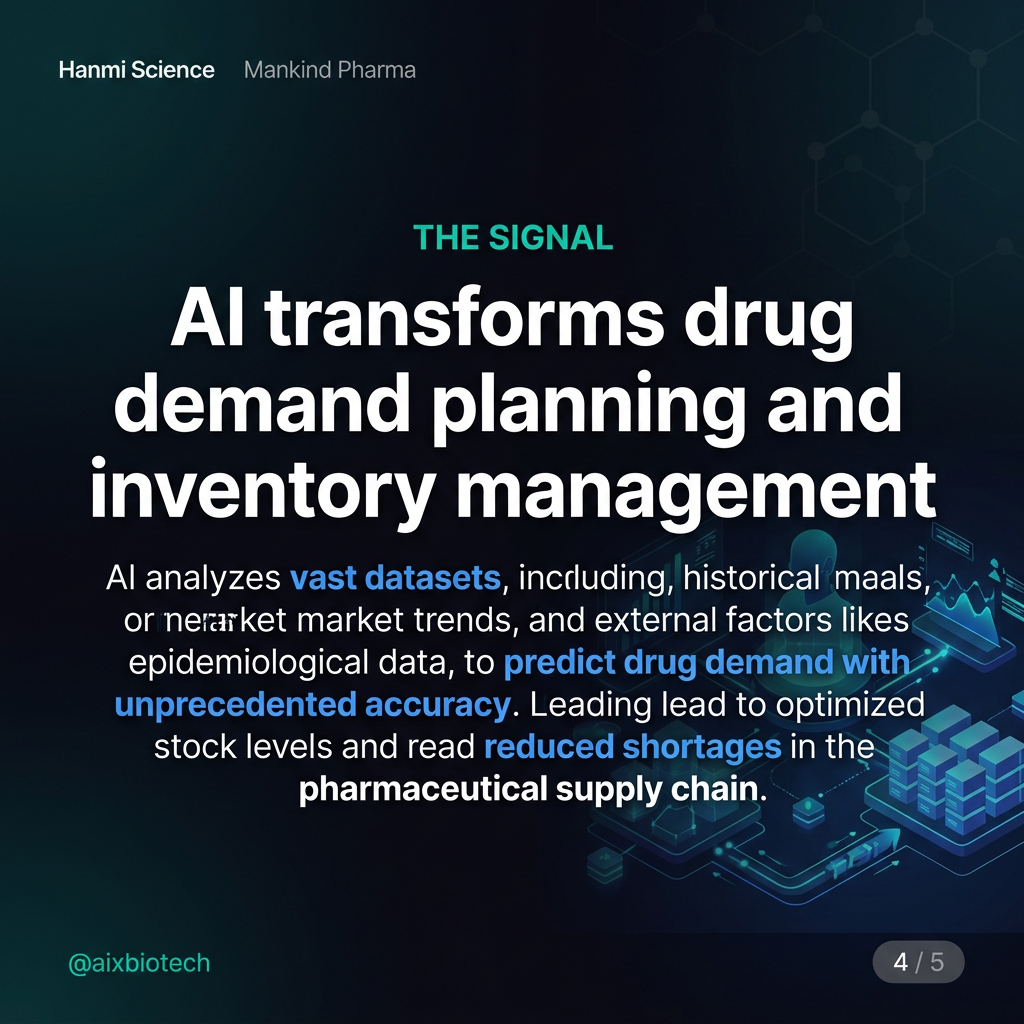
AI forecasting models work differently. They process multiple data streams simultaneously: disease incidence trends, HCP prescribing patterns, payer and formulary changes, competitor stock movements, and seasonality signals. They identify correlations that no human analyst can find manually across millions of data points.
The result is a forward-looking demand signal, updated in real time, that commercial teams can actually act on.
Why AI Specialty Drug Demand Forecasting Matters for Commercial Teams
This is not just an operations improvement. It is a commercial strategy advantage.
When your demand forecast is accurate, your entire commercial operation sharpens. Territory investment is based on real patient flow data. Field force deployment aligns to where demand is actually building. Launch decisions are made with a forward view rather than a rearview mirror.
The financial impact is direct. A 10% improvement in forecast accuracy on a $500 million specialty product translates into tens of millions in avoided waste, better launch pacing, and more reliable inventory commitments to specialty pharmacies and distributors.
According to IQVIA’s white paper on AI in life sciences commercialization, forecasting is already one of the top AI investment priorities for commercial teams in life sciences. ZS Associates’ 2025 survey confirmed accelerating data and AI investment in life sciences, with commercial forecasting as a primary driver.
McKinsey estimates AI could generate $60 to $110 billion per year in economic value for pharma and medical products. A meaningful portion of that comes from commercial operations, not just R&D.
Top AI Use Cases in Specialty Drug Demand Forecasting With Immediate ROI
The case of Hanmi Science, documented by Impactive AI using the Deepflow Forecast platform, shows what is already achievable.
The company deployed AI demand forecasting across more than 60 pharmaceutical products. The system analyzed over 6 million data points in real time, incorporating disease patterns, prescription trends, seasonality, and competitor dynamics.
Results were specific and verifiable:
- Sales forecast accuracy of 80.1% at a six-month horizon
- Patient number prediction accuracy of 96.5% across 224 disease categories
- Out-of-stock rate reduced by 22.6%
- Excess inventory reduced by 32.5%
- Monthly inventory costs cut by 55.1%
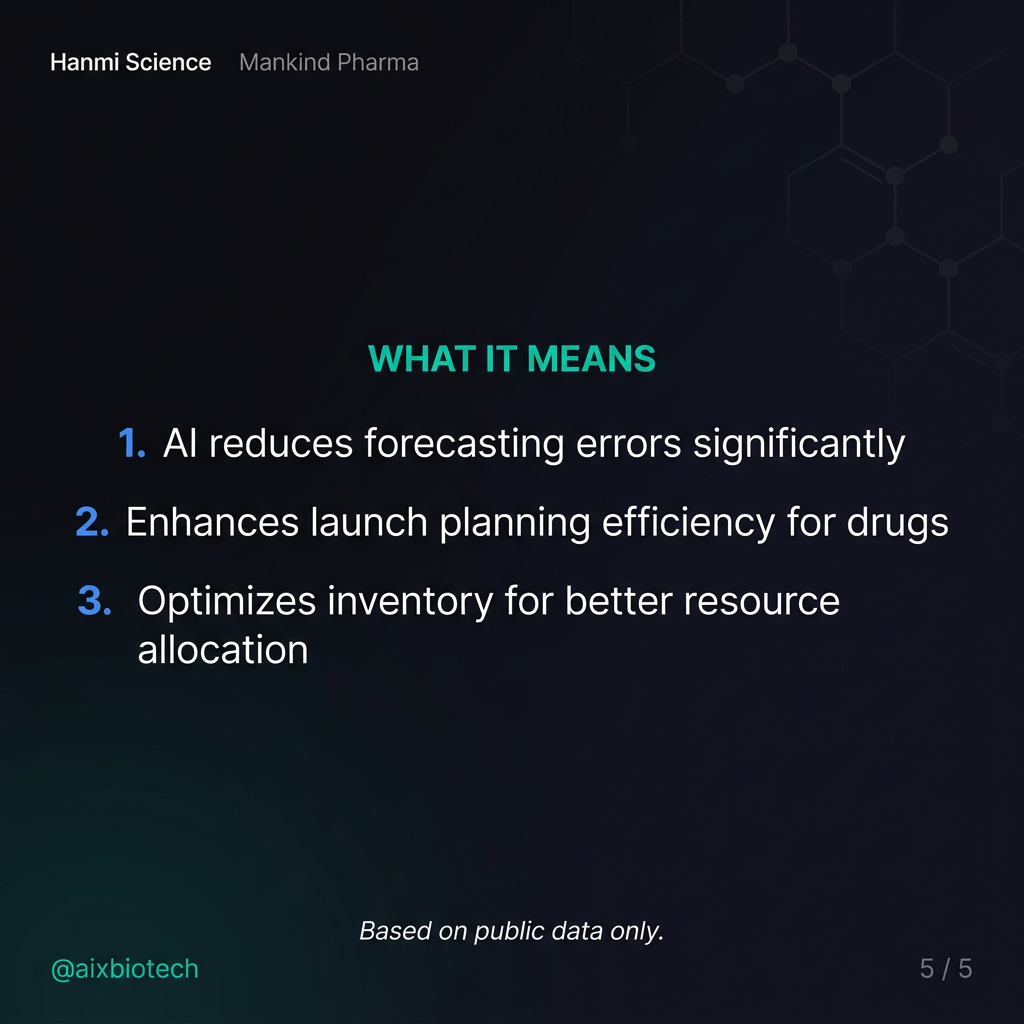
- Time spent on forecasting tasks reduced by 80%
The 80% time saving is significant beyond efficiency. Tasks that required teams to manually review dozens of Excel files were fully automated. That is not just cost reduction. It is your commercial team’s attention redirected toward strategy.
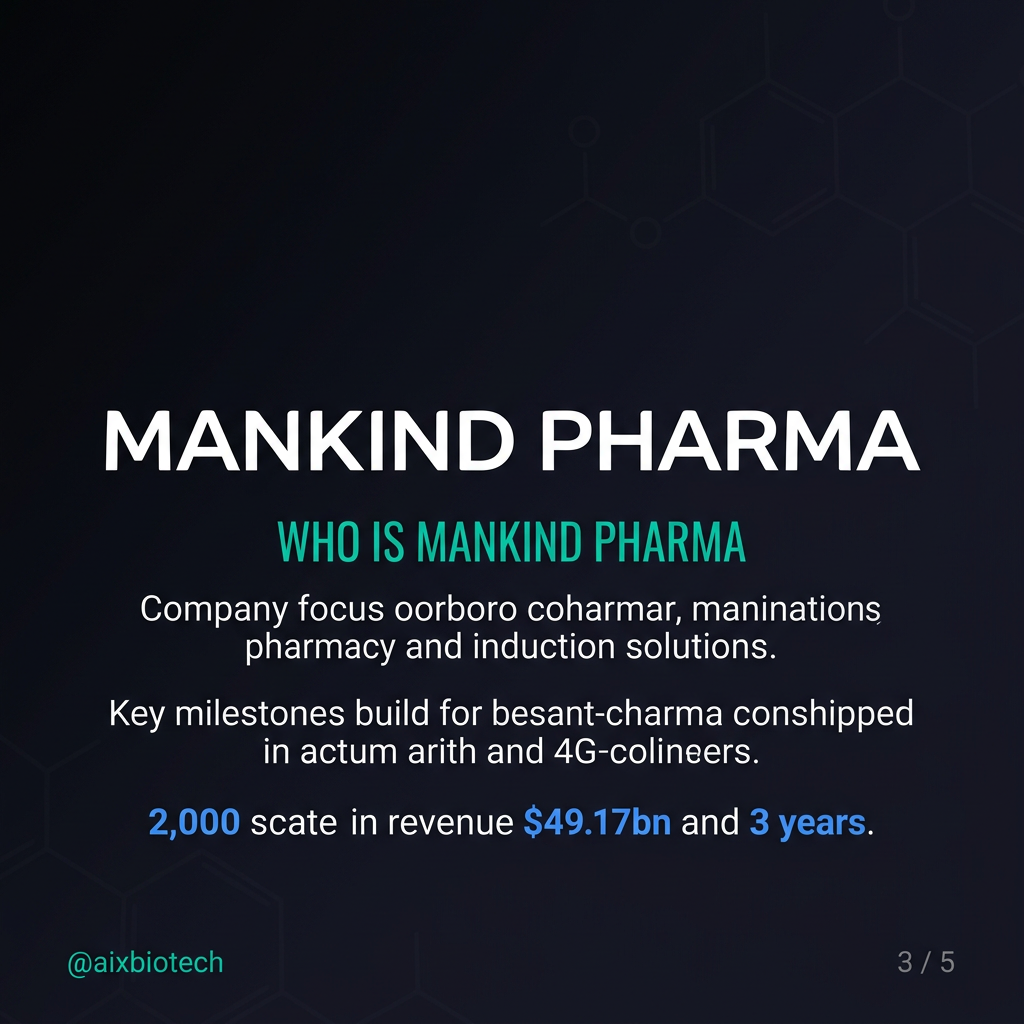
Mankind Pharma achieved a parallel result. Using AI-driven supply chain optimization, the company cut stockouts by 75%, according to a case study published by Traxtech (2025).
Across industries using AI demand forecasting, consistent patterns emerge: 20 to 35% working capital freed, 65% fewer stockouts, 20 to 30% lower average inventory levels. In specialty pharma, where inventory carrying costs run into the tens of millions annually, these are not marginal gains.
The Five Reasons Specialty Drug Forecasting Is Uniquely Hard
Understanding why traditional models fail helps explain why AI forecasting delivers so consistently in this context.
- Small patient populations. A rare disease drug may serve 5,000 patients globally. One formulary decision can shift your quarterly number by 20%.
- HCP-concentrated prescribing. A handful of specialist centers drive the majority of volume. Prescribing behavior is hard to predict from sales data alone.
- Payer unpredictability. Formulary changes and prior authorization shifts move demand in ways that historical data cannot anticipate.
- Biologic complexity. Cold chain requirements, dosing schedules, and adherence patterns add variability at every stage.
- Launch sensitivity. In specialty, the first six months define the product lifecycle trajectory. A misread ramp curve has long-term consequences.
Where AI Pharma Demand Forecasting Works on Non-Regulated Data
The most effective current applications use commercial data that is already structured, accessible, and non-regulated.
- Sell-out and sell-in data. IQVIA, Symphony Health, and similar providers give commercial teams access to anonymized prescription and sales data at a granular level.
- HCP prescribing patterns. Veeva’s platform captures field force interactions and prescribing behavior across specialist networks. AI identifies movement before it appears in sales data.
- Payer and formulary data. AI models the downstream demand impact of a formulary change within days, not quarters.
- Disease incidence data. Publicly available epidemiology datasets improve patient flow forecasting for rare diseases and specialty indications.
- Competitor signals. Market intelligence on competitor inventory and launch timelines feeds into models and helps anticipate volume shifts.
These data sources are non-regulated, non-proprietary, and commercially available. AI forecasting built on this data does not require clinical compliance infrastructure.
Important: always confirm with your IT and legal teams before any AI tool touches regulated data, patient-level records, or unpublished clinical information. Regulated workflows, GxP environments, and clinical submissions require separate compliance validation before any AI tool is deployed.
The Platforms Leading AI Forecasting in Specialty Pharma
IQVIA has built what it calls IQVIA Agentic AI and Commercial Orchestration. The platform processes IQVIA’s proprietary data assets alongside client commercial data for demand forecasts, territory predictions, and launch readiness signals. The August 2025 long-term partnership between IQVIA and Veeva confirmed integrated commercial AI as a strategic priority for both platforms.
Veeva brings commercial CRM and data management with increasing AI integration. Their 2025 commercial predictions flagged AI-driven data standards and new engagement models as central to specialty commercial operations going forward.
ZS Associates provides consulting-led AI analytics with deep expertise in specialty drug markets. Their 2025 survey data confirms accelerating investment in commercial AI across their life sciences client base.
For smaller biotech teams that cannot deploy enterprise platforms immediately: start with structured sell-out data, a forecasting tool that can run machine learning models, and a monthly update cadence. The barrier to starting is lower than most commercial leaders assume.
How to Implement AI in Specialty Drug Demand Forecasting
Most commercial teams are not starting from zero. They have data. What they lack is a structured approach to turning it into a forward-looking model.
- Audit your data sources first. Map what commercial data you actually have: sell-in, sell-out, HCP interactions, payer coverage, patient services. Forecast quality is determined by input quality.
- Start with one product or one market. Pick your highest-complexity specialty product and run a pilot. Define accuracy targets before you start, not after.
- Measure decision quality, not just model accuracy. Did the forecast enable better territory investment? Fewer emergency supply interventions? Better launch pacing? Those are the outcomes that matter to leadership.
- Map your current commercial data sources
- Identify your highest-complexity specialty product as pilot
- Define forecast accuracy baseline before AI deployment
- Get IT and legal sign-off on data sources to be used
- Set a 90-day review cadence to measure impact
The Bottom Line
Half of pharma launches miss their first-year targets. For specialty drugs, the margin for error is even tighter. AI forecasting models that process millions of data points in real time are already producing results that manual methods cannot match.
A 55% reduction in inventory costs. A 75% drop in stockouts. An 80% cut in the time your team spends building the forecast.
The technology is ready. The data is available. The question for every specialty commercial leader is how much longer they can afford to run on spreadsheets and intuition.
Want more signals on AI in biotech? Read our analysis on the latest in biotech innovation and AI and robotics in life sciences.
FAQ: AI in Specialty Drug Demand Forecasting
What is AI used for in specialty drug demand forecasting?
AI processes multiple data streams simultaneously: sell-out data, HCP prescribing patterns, disease incidence trends, payer and formulary signals, and competitor stock movements. This produces a forward-looking demand signal updated in real time, far more accurate than models built on historical data alone.
How much can AI reduce inventory costs in specialty pharma?
Documented results show reductions of 20 to 55% in inventory costs depending on product complexity and data quality. Hanmi Science achieved a 55.1% reduction in monthly inventory costs after deploying AI demand forecasting across 60+ pharmaceutical products (Impactive AI, 2024).
What are the main AI use cases in specialty drug commercial operations?
The highest-ROI use cases are demand forecasting, stockout prevention, launch ramp modeling, HCP prescribing pattern analysis, and territory performance prediction. All operate on non-regulated commercial data and do not require clinical compliance infrastructure to deploy.
Is AI demand forecasting in pharma regulated?
AI tools used on commercial and market data are not subject to GxP or 21 CFR Part 11 regulation. However, any AI tool that touches patient-level data, clinical trial data, IND or NDA submissions, or unpublished compound data must be validated under the applicable regulatory framework. Always get IT and legal sign-off before deployment in any regulated workflow.
Which platforms offer AI demand forecasting for specialty pharma?
The leading platforms are IQVIA (IQVIA Agentic AI and Commercial Orchestration), Veeva (commercial CRM and data), and ZS Associates (consulting-led commercial analytics). Smaller teams can start with structured sell-out data and ML-capable forecasting tools before moving to enterprise platforms.
Demand forecasting does not operate in isolation. The same data infrastructure driving better forecasts also powers distributor margin management and territory planning. See how AI is closing the $356 billion distributor margin gap in biotech and how AI is cutting supply chain costs across biotech for how leading biotech commercial teams are connecting these capabilities.