
Your biotech supply chain is probably running on a combination of spreadsheets, SAP modules from 2008, and institutional knowledge that walks out the door when someone retires. That is not a technology problem. It is a competitive liability.
The companies that figure this out first will not just reduce costs. They will move faster, carry less inventory risk, and get products to market in timelines their competitors cannot match. The ones that wait will spend the next three years explaining to their board why margins keep compressing.
What Is Actually Happening
Artificial intelligence is moving from experimental to operational across pharma and biotech supply chains. This is not vendor marketing. The data is in.
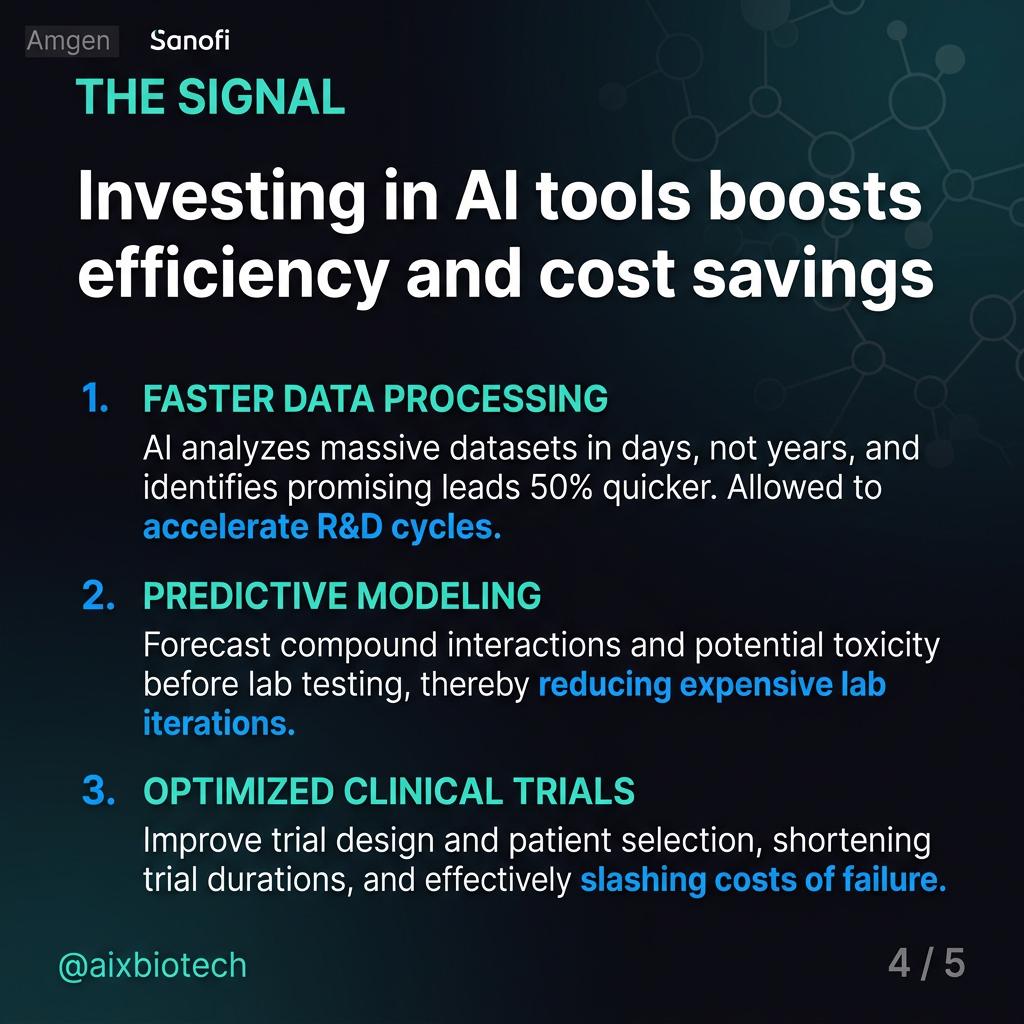
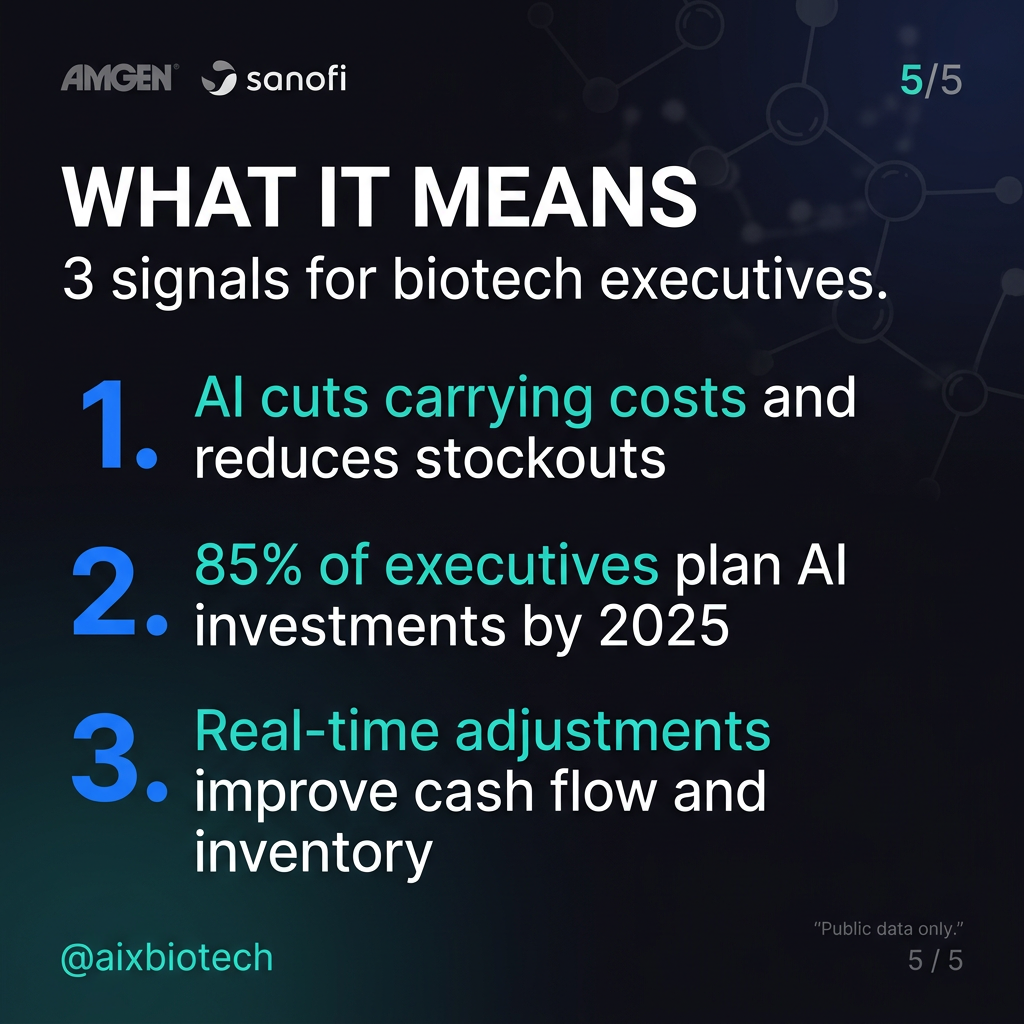
According to a 2025 ZS Associates survey of biopharma executives, more than 85 percent plan to invest in AI and digital tools specifically for supply chain resilience this year. That is not a pilot budget. That is a structural shift in where capital is going.
McKinsey analysis of AI in distribution operations found that embedding AI into supply chain functions delivers inventory reductions of 20 to 30 percent and cost decreases of 5 to 20 percent. In a sector where carrying costs for temperature-sensitive biologics can run into tens of millions annually, those are material numbers.
Mankind Pharma, one of India largest pharmaceutical companies, reported a 75 percent reduction in stock-outs after implementing an AI-driven supply chain model in 2025 (Trax Technologies, February 2026). Not a marginal improvement. A fundamental change in how inventory behaves.
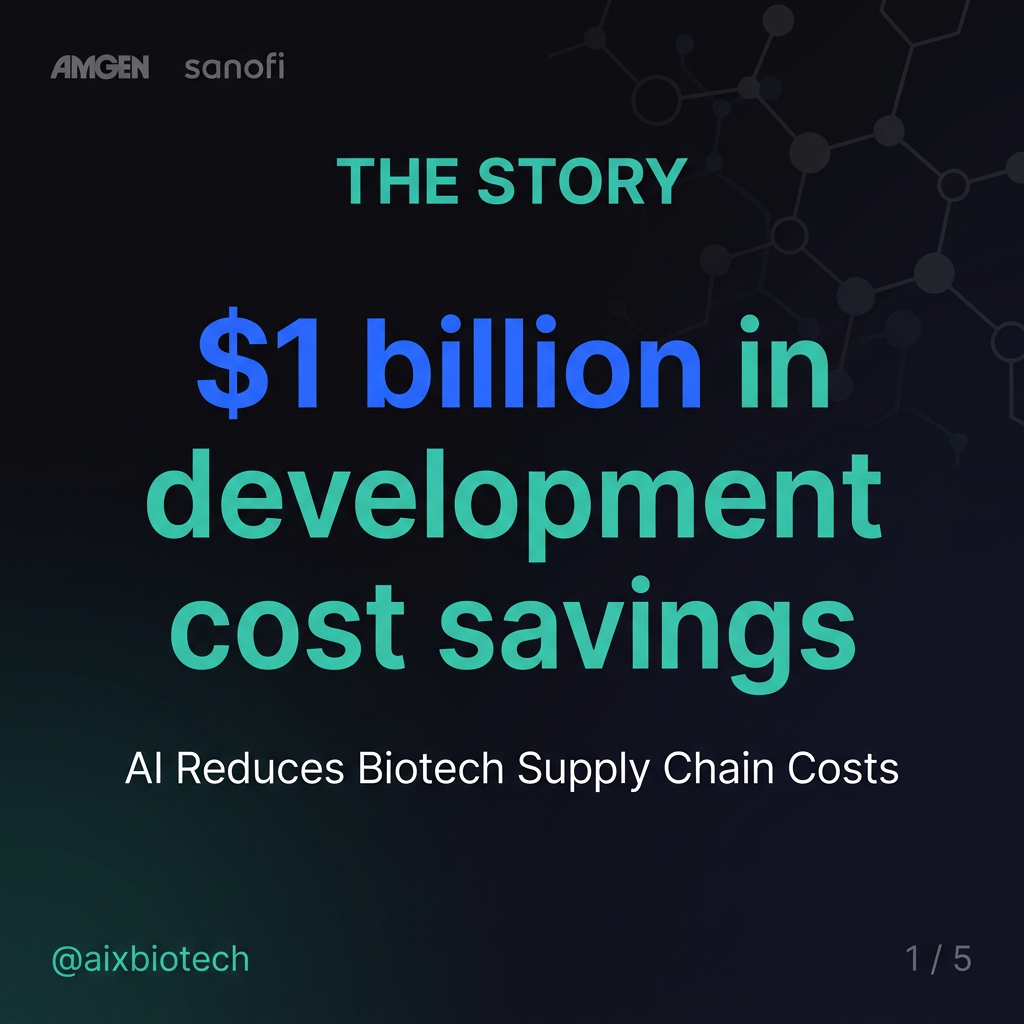
ZS Associates analysis of one unnamed top-10 pharma company projected savings of approximately one billion dollars in development and operational costs over five years through AI-driven optimisation. Supply chain represents a significant portion of that figure.
Why This Matters for Biotech Operators
Supply chains in biotech are not like supply chains in consumer goods. You are dealing with temperature-sensitive biologics, active pharmaceutical ingredients with single-source suppliers, regulatory release timelines, expiry dates that shrink your distribution window, and demand patterns that can shift overnight based on a competitor trial readout or a payer formulary decision.
Traditional forecasting models were not built for this. They rely on historical sales data and static safety stock calculations reviewed quarterly. By the time a signal appears in your data, you are already behind.
- Carrying cost exposure: Excess inventory in biologics is not just a working capital problem. Temperature excursions, write-offs, and reprocessing costs make overstocking actively destructive. AI-driven demand forecasting reduces excess inventory by 20 to 30 percent (McKinsey, 2025). In a mid-sized biotech with a $200M inventory position, that is $40M to $60M in freed capital.
- Stock-out risk in critical therapies: A stock-out in oncology or rare disease is not a customer service issue. It is a patient safety event, a regulatory flag, and a commercial disaster. Mankind Pharma 75 percent reduction in stock-outs shows what AI can deliver when it processes demand signals, production capacity, and distribution constraints simultaneously.
- Supply network fragility: Post-COVID disruption exposed how dependent the industry is on single-source API suppliers, particularly in Asia. AI systems now monitor geopolitical risk signals, supplier financial health, and logistics capacity in real time, flagging disruptions weeks before they materialise. TraceLink 2025 LogiPharma AI Report documents companies using AI network intelligence to pre-position safety stock before crises hit.
- Regulatory and serialisation compliance: AI is reducing the manual burden of track-and-trace compliance under DSCSA and EU FMD. TraceLink OPUS platform, expanded significantly in 2025, automates compliance data exchange across multi-enterprise supply networks.
- Speed to commercial launch: AI-driven supply chain planning is compressing time between regulatory approval and first patient dose by an estimated 15 to 25 percent, according to Pharma IQ (2025).
Real-World Application: Sanofi AI-Driven Supply Network
Sanofi is one of the most documented cases of AI deployment at scale in a global pharma supply chain. Working with a broad data infrastructure, Sanofi enabled cross-functional access to supply chain data for thousands of employees, allowing AI-assisted decision-making at every level of the network (Gartner, 2025).
Planners stopped working from weekly batch reports. They started working from real-time dashboards that flag anomalies, suggest reorder actions, and model the downstream consequences of supply disruptions before they cascade.
Sanofi also partnered with OpenAI and Formation Bio in 2025 to develop AI tools that reduce patient recruitment timelines from months to weeks. The downstream effect on supply chain is direct: earlier clarity on demand ramp timelines means more accurate production scheduling and less emergency inventory repositioning.
The Three AI Use Cases With Immediate ROI
Not everything in AI supply chain delivers the same return. Three use cases consistently generate the fastest payback based on deployments across the sector in 2024 and 2025.
1. AI-powered demand forecasting. Traditional statistical models achieve around 70 to 75 percent accuracy in pharmaceutical demand prediction. AI models incorporating external signals, including payer coverage changes, competitive launches, seasonal disease patterns, and prescriber behaviour data, consistently achieve 85 to 92 percent accuracy. The value is in the reduction of both overstock write-offs and emergency procurement costs.
2. Dynamic safety stock optimisation. Static safety stock models do not adapt. AI models recalculate safety stock continuously based on real-time supplier performance data, logistics variability, and shifting demand signals. Amgen, which doubled clinical trial enrolment speed using AI-driven tools (ZS Associates, 2025), has deployed AI across its manufacturing and operations to reduce inventory positions while maintaining service levels.
3. Supply risk monitoring and early warning. TraceLink Multienterprise Information Network Tower, winner of the 2025 BSMA Supply Chain Management Innovation Award, tracks supplier performance, regulatory status, logistics provider reliability, and market signals across a connected network of pharma companies and partners. Early warning of a potential API shortage gives commercial teams weeks to respond. That time is the difference between a managed disruption and a supply crisis.
How to Start: Practical Steps for Biotech Ops Teams
The barrier is rarely the technology. It is data readiness, change management, and knowing where to begin. Here is a practical sequence based on what is working across the sector.
- Start with your highest-risk SKUs. Identify the five to ten products where a stock-out creates the most damage commercially or from a patient safety perspective. These have enough data history to train a model and enough consequence to justify organisational change.
- Fix your data infrastructure first. AI demand forecasting is only as good as the data it trains on. If demand signals live in five different systems and inventory positions are reconciled manually every week, no AI tool will deliver value. The first investment is a clean, connected data layer integrating ERP, WMS, demand planning, and commercial data.
- Keep regulated data out of the first wave. AI tools in supply chain operate on operational data: demand forecasts, procurement records, distributor performance, logistics data. None of this falls under GxP or 21 CFR Part 11. The moment you connect AI tools to batch records or regulatory submissions, you are in a different compliance environment. Get IT, legal, and quality sign-off before going there.
- Set baselines before you start. Forecast accuracy, inventory turns, stock-out frequency, carrying cost as a percentage of revenue. Without a baseline, you cannot demonstrate value and cannot get budget for the next phase.
- Build a small AI Centre of Excellence. The 2025 Pharma IQ report identifies Intelligence Centres of Excellence as the structural difference between companies that scale AI and those that run isolated pilots forever. Three to five people with cross-functional mandate, data science capability, and supply chain domain knowledge can drive enterprise-wide adoption if they have executive sponsorship.
The Business Case in Numbers
Inventory reduction of 20 to 30 percent on your total position (McKinsey, 2025). For a biotech with a $150M inventory position, that is $30M to $45M in freed working capital, with associated carrying cost reduction of 15 to 25 percent of that figure annually.
Stock-out reduction of 50 to 75 percent (Mankind Pharma, Trax Technologies, 2026). Each stock-out event in a specialty product can cost $500K to several million in lost sales, patient switching, and emergency logistics.
Procurement cost reduction of 5 to 15 percent through better supplier visibility and reduced emergency purchasing (McKinsey, 2025). Emergency procurement in pharma carries a 30 to 50 percent premium. AI early warning systems reduce how often that happens.
Payback period for well-implemented AI supply chain programmes in pharma and biotech is typically twelve to eighteen months based on current deployment data. That compares favourably with most capital investments in the sector.
What Comes Next
The 2026 pipeline for AI in pharma supply chains is moving toward agentic systems: AI that does not just forecast and alert, but takes autonomous actions within defined parameters. Reorder triggers, carrier selection, lot allocation decisions. TraceLink OPUS platform is already scaling agentic orchestration across global life sciences networks in 2026.
BCG 2025 biopharma trends report projects that AI could reduce preclinical discovery time by 30 to 50 percent and lower costs by 25 to 50 percent. The operational infrastructure to commercialise those discoveries faster, at lower cost, with better supply reliability, is being built right now.
85 percent of your competitors are already deploying capital here. The question is not whether AI will reshape pharma and biotech supply chains. It already is. The question is whether your organisation is on the right side of that shift when the margin difference shows up in your next earnings report.
Key Takeaway
AI in biotech supply chain is not a future investment. It is a present competitive advantage. The companies acting now are building cost structures and speed-to-market capabilities that will be very difficult to replicate in three years. The window to move first is closing.
Based on publicly available information. This analysis covers non-proprietary, publicly disclosed data only. Sources: ZS Associates (2025), McKinsey and Company (2025), Trax Technologies (2026), TraceLink (2025), Pharma IQ (2025), BCG (2025), Gartner (2025).