
AI in CDMO selection and management: how to pick the right partner and hold them accountable
More than 50% of global biotech drug manufacturing is handled by contract development and manufacturing organisations. For most biotech companies, the CDMO is the single most critical external dependency in their supply chain. A CDMO failure does not just affect operations. It affects clinical timelines, launch dates, and investor confidence.
IQVIA data from 2025 attributes 35% of clinical and commercial supply chain delays in biotech to poor CDMO selection and management. That is a large and largely avoidable problem.
Why traditional CDMO selection is structurally inadequate
The traditional CDMO selection process relies on a site visit, a capabilities presentation, a technical questionnaire, and reference checks with two or three clients the CDMO selected themselves. This process has four structural weaknesses.
First, the site visit is a point-in-time snapshot. It shows you what the facility looks like on the day you visit, with staff prepared for the visit. It does not show you what the facility looks like under production pressure six months into your programme.
Second, reference checks are inherently biased. No CDMO provides references from clients with whom the relationship went poorly. The reference sample is selection-filtered to show the best outcomes.
Third, the technical questionnaire captures stated capability, not demonstrated performance. A CDMO can accurately describe a process it has never successfully executed at commercial scale.
Fourth, capacity is a dynamic variable that most selection processes treat as static. A CDMO that had available capacity when you signed may have filled that capacity with other programmes by the time your manufacturing slot arrives.
Key stat: Poor CDMO selection and management is responsible for 35% of clinical and commercial supply chain delays in biotech. Source: IQVIA Institute, 2025.
What AI CDMO intelligence tools do
AI CDMO tools operate across the full partner lifecycle: pre-selection scoring, ongoing performance monitoring, and capacity forecasting.
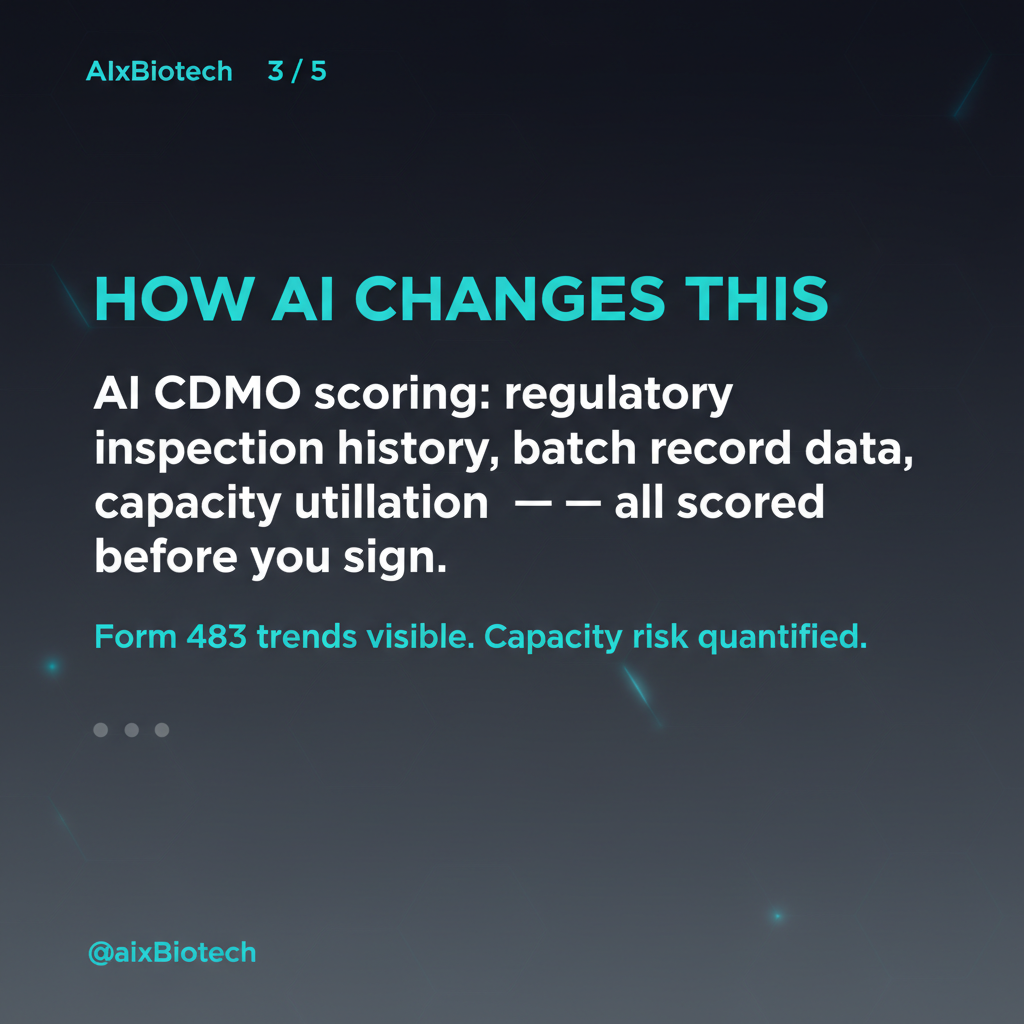
Pre-selection scoring pulls together public regulatory inspection records (FDA warning letters, EMA inspection findings, Form 483 observations), batch record data from public sources, deviation and recall histories, capacity utilisation estimates from public filings, and client programme announcements. The AI model synthesises these signals into a capability score that reflects demonstrated performance, not stated capability.
A CDMO with a strong capabilities deck but a history of Form 483 observations in aseptic processing will score differently from one with clean inspection records and a track record of on-time commercial launches. This distinction is invisible in a traditional RFP process. It is explicit in an AI-scored capability assessment.
Ongoing performance monitoring tracks real-time signals during the active relationship: regulatory inspection outcomes at the facility, any public quality alerts associated with products manufactured at the site, capacity announcements that might indicate your programme is being deprioritised, and deviation reports that flow through your quality agreement.
Capacity forecasting models the CDMO’s likely production load based on publicly announced programmes and historical production volumes. A CDMO that takes on three new commercial programmes in the same technology platform as your product in a six-month period has a materially different capacity risk profile than it had at contract signature.
Practical deployment for a biotech supply chain team
The starting point is building a CDMO intelligence dashboard before your next selection process, not during it. AI CDMO tools need time to aggregate and normalise data. Starting the data collection 12 months before a selection decision gives the AI model enough signal to produce a reliable capability score.
Connect the AI CDMO monitoring system to your quality agreement milestones. When a CDMO deviation reaches a threshold in the AI monitoring system, it should automatically trigger a review against the quality agreement terms. This creates a documented, auditable response process that protects you in any subsequent dispute.
Use AI capacity forecasting to set contract terms. If the AI model identifies that your CDMO is likely to be at capacity during your expected production window, build capacity reservation clauses into the contract before you sign. This is cheaper and less disruptive than managing a capacity conflict during a critical production run.
Our analysis of AI cold chain optimisation for biologics covers the downstream supply chain dimension. CDMO selection and cold chain management are two sides of the same external dependency risk, and are most effectively managed with connected data infrastructure.
FAQ
Does AI CDMO scoring replace the site audit?
No. Site audits are a GxP requirement for qualified manufacturer qualification and cannot be replaced by AI scoring. AI pre-selection scoring improves the quality of the site audit shortlist and the questions you bring to the audit, but does not replace the audit itself.
What data inputs does AI CDMO scoring require?
Public regulatory inspection records, batch record data from public sources, and capacity data from public announcements. Proprietary data from the CDMO (internal deviation rates, batch failure rates) requires a quality agreement disclosure clause. AI scoring on public data alone is sufficient for pre-selection; proprietary data improves ongoing monitoring.
How do you manage a CDMO relationship when the AI monitoring flags a concern?
The AI alert triggers a pre-defined escalation protocol: review the specific signal, assess its materiality to your programme, and initiate a formal dialogue with the CDMO within a documented timeframe. The AI monitoring creates an evidence trail that supports a structured conversation, not an accusation. The goal is early intervention, not confrontation.
The CDMO relationship is too important to manage on intuition and quarterly calls. AI gives you the continuous visibility to manage it like the strategic dependency it is.
Based on publicly available information. This analysis covers non-proprietary, publicly disclosed data only.