

AI Price Corridor Modeling for Biotech: How to Stop Leaving Money on the Table Across Every Market
In 2026, getting the price wrong on a biotech launch is not just a commercial problem. It is a strategic one that takes years to fix. The MFN executive order signed by President Trump in May 2025 formally tied US pricing to international reference benchmarks. The Inflation Reduction Act is applying Medicare negotiation pressure from the other direction. And international reference pricing linkages mean that a low price accepted in Germany or France does not stay in Germany or France. It travels. Fast. The biotech teams still managing this with spreadsheets and static models are flying blind.
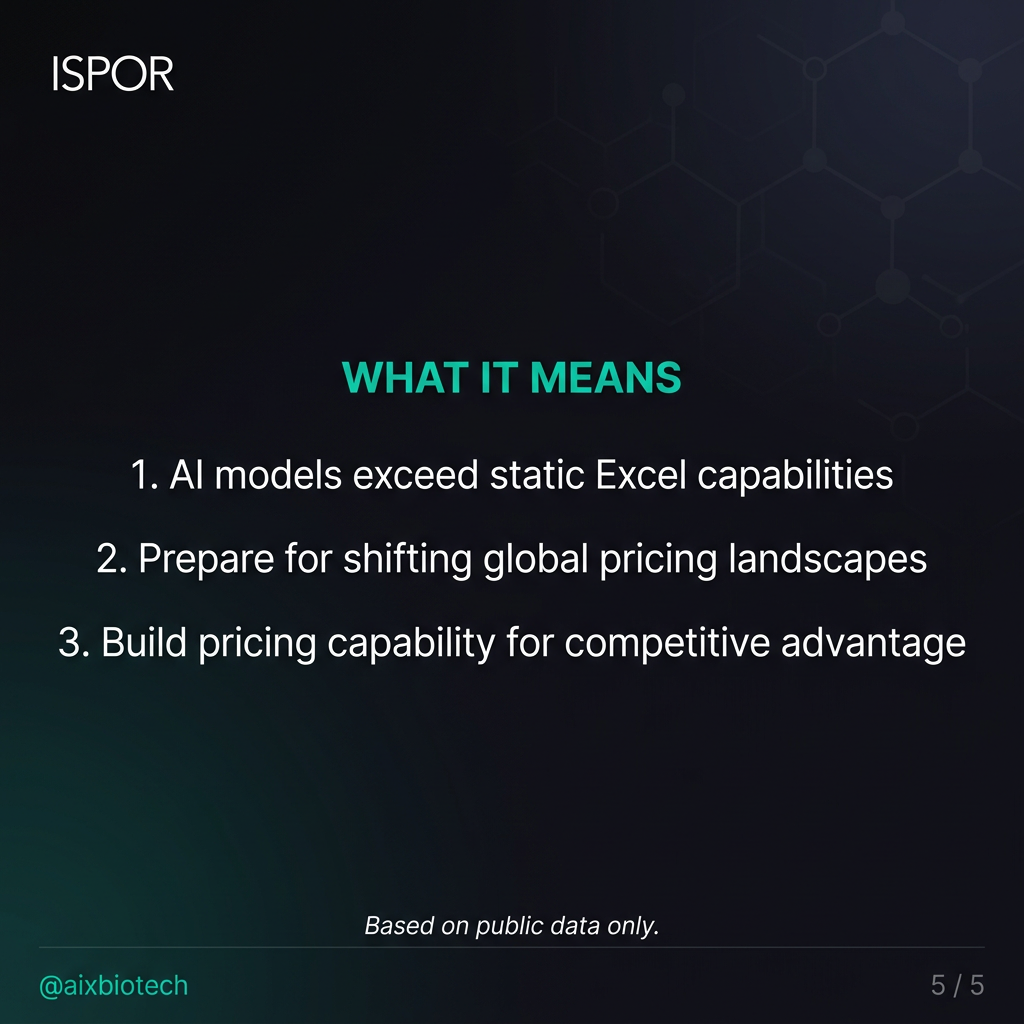
AI price corridor modeling changes the equation. It does not replace the pricing strategist. It gives that strategist a dynamic, multi-market intelligence layer that would take a team of analysts weeks to build manually, updated continuously, and queryable in minutes.

Why Pharma Pricing Strategy Became Corridor Management
Remap Consulting’s 2026 pharma pricing strategy analysis describes the current environment precisely: winning teams are running pricing as a corridor-management discipline, with explicit scenario planning, not as a one-time launch decision. That shift is structural, not cyclical.
The MFN executive order, signed on May 12, 2025 (ISPOR, 2025), requires that US drug prices align with the lowest prices paid by comparable countries. The IRA’s Medicare negotiation framework caps prices from below. International reference pricing linkages in the EU, Japan, Australia, and across emerging markets mean that every price set in every market creates a reference point that limits or enables pricing in other markets. A price accepted in a smaller market to gain early access can trigger automatic price reductions in larger markets through IRP mechanisms.
Managing this complexity manually, with static models updated quarterly, is no longer adequate. The data volume is too large, the linkages are too numerous, and the update frequency required is too high for human teams working without AI support.

What AI Price Corridor Modeling Actually Does
An AI-driven price corridor model continuously ingests publicly available pricing data across reference markets, HTA decisions, reimbursement approvals, and IRP trigger mechanisms. It models the downstream pricing implications of every launch price decision across every market in the launch sequence. It runs scenarios in real time rather than in quarterly planning cycles.
For a market access director managing a launch across the US, Germany, France, the UK, Japan, and a set of emerging markets, this means being able to answer three questions that previously took weeks to model. What is the highest price achievable in the US without triggering unacceptable IRP spillover into EU5 markets? What is the optimal launch sequence to protect the US price while achieving early access in key European markets? If Germany’s AMNOG process results in a lower-than-expected additional benefit rating, what does that do to the corridor in Austria, Switzerland, and the CEE markets?
These are not hypothetical questions. They are the exact decisions that determine whether a launch captures its revenue potential or leaves hundreds of millions on the table over a product’s commercial life.

Why This Matters for Biotech Market Access Teams
- IRP spillover is accelerating: The MFN executive order has made US pricing directly dependent on international reference prices for the first time. A low price in any reference country now has potential US commercial consequences. AI corridor models track these linkages in real time.
- Launch sequencing decisions have permanent consequences: Simon-Kucher’s 2025 global launch sequencing analysis found that pharma leaders are fundamentally rewriting their launch playbooks under new pricing reform pressures. The order in which markets are entered defines the price floor in every subsequent market.
- HTA timelines are compressing: EU Joint Clinical Assessment came into full effect in 2025 for oncology and ATMPs. Multi-market HTA submissions require coherent pricing narratives across markets simultaneously. AI models that update corridor projections as each HTA outcome lands give teams real-time course-correction capability.
- Static models miss dynamic interactions: A spreadsheet model updated quarterly cannot capture how a price revision in one market propagates through IRP linkages into six others within weeks. AI-driven models update continuously as new data becomes available.
- The RWE market is growing fast: MarketsandMarkets valued the global real-world evidence solutions market at $5.42 billion in 2025, projecting 14.8% CAGR through 2030. Payers are demanding RWE at the table. AI models that integrate RWE signals into price corridor projections are increasingly what sophisticated market access teams are building toward.
A Concrete Example: EU Launch Sequence Under MFN Pressure
Consider a mid-size biotech launching a specialty oncology asset in 2026. The US is the primary revenue market. Germany is the preferred European entry point because AMNOG allows free pricing for the first 12 months before the additional benefit assessment. France and the UK reference Germany. Austria and Switzerland reference Germany and France. Several CEE markets reference Austria and the UK.
Without AI corridor modeling, the team runs a static Excel model in Q1 and updates it after each market decision. By the time the Germany AMNOG outcome lands, the model is three months old and the downstream IRP calculations are based on assumptions that are no longer current.
With an AI corridor model, the team runs continuous scenario analysis throughout the AMNOG process. As the additional benefit rating becomes clearer through the dossier review, the model updates the projected corridor across all downstream markets in real time. The team arrives at the final price negotiation with the GKV-Spitzenverband knowing exactly what the floor is to protect the US corridor, and where they have room to move without triggering damaging IRP cascades elsewhere.
For context on how AI is reshaping the commercial function more broadly, see how AI is closing the $356 billion distributor margin gap in biotech and how AI is improving specialty drug demand forecasting for commercial teams.

How to Start Building AI Price Corridor Capability
- Audit your current pricing data infrastructure: Before any AI tool can model corridors effectively, the underlying data needs to be structured. Published prices, IRP linkage rules, HTA outcomes, and reimbursement decisions across your key markets need to be in accessible, machine-readable format. Start with the 10 to 15 markets that matter most to your portfolio.
- Map your IRP linkage network explicitly: Most biotech market access teams have a general understanding of which markets reference which. AI corridor modeling requires a precise, up-to-date linkage map with trigger mechanisms, timing rules, and weighting factors.
- Run scenario analysis before launch, not after: The highest-value application of AI corridor modeling is in pre-launch scenario planning, when pricing decisions can still be changed. Teams that introduce AI modeling mid-launch are correcting mistakes rather than preventing them.
- Integrate HTA outcomes as inputs, not outputs: The most sophisticated corridor models treat HTA decisions as dynamic inputs that update price projections in real time.
- Start with publicly available data only: Published prices from IQVIA, Evaluate, and public reimbursement databases are sufficient to build meaningful scenario models. No proprietary patient data or unpublished regulatory submissions are required. IT and compliance sign-off on the data sources before any AI tool touches them.
Key Takeaway
Pharma pricing in 2026 is corridor management, not launch pricing. MFN, IRA, and international reference pricing linkages have made every price decision a multi-market, multi-year commitment with cascading consequences. AI corridor modeling gives market access teams the real-time scenario intelligence to manage those consequences proactively. The teams building this capability now are setting price floors their competitors will spend years trying to match.
Frequently Asked Questions
What data does AI price corridor modeling require?
Effective AI corridor models can be built on publicly available data including published list prices from major markets, HTA outcomes from AMNOG, NICE, HAS, and other agencies, reimbursement approvals, and IRP linkage rules published by national authorities. Proprietary patient data, unpublished clinical data, and regulatory submissions are not required and should never be entered into AI tools without validated, controlled infrastructure and compliance clearance.
How does the MFN executive order affect international launch sequencing?
The MFN executive order signed in May 2025 requires US drug prices to align with the lowest prices paid in comparable reference countries. This creates a direct linkage between international launch prices and US commercial outcomes for the first time. Biotech teams must now model US price implications as part of every international launch sequence decision.
Can AI replace the market access pricing strategist?
No. AI price corridor models handle data aggregation, scenario computation, and real-time updating of IRP linkage projections. The strategic judgements about which markets to prioritise, what access trade-offs to accept, and how to frame value arguments for specific payer audiences require human expertise that AI cannot replicate.
Based on publicly available information. This analysis covers non-proprietary, publicly disclosed data only. References: ISPOR (2025), Remap Consulting (2026), Simon-Kucher (2025), MarketsandMarkets (2025).