
AI Is Not Just a Work Tool. It Is a Personal Competitive Weapon. Are You Using It?
There is a split happening right now inside pharma and biotech organisations. It is not about seniority or salary band. It is not about which team has the bigger budget or the better strategy. It is quieter than that, and more consequential. Some professionals are walking into every meeting already prepared. They have read the briefing documents, pre-analysed the data, anticipated the objections, and drafted their position. Not because they worked three extra hours the night before. Because they spent twenty minutes with an AI assistant that did the heavy lifting for them.
The others are still preparing the way they always have. And the gap is widening every quarter.
What Staying Current Actually Means in 2026
Keeping up with AI is no longer about reading the right newsletters or attending the right conferences. That was enough in 2022. In 2026, the bar is different. Staying current means being able to apply it, in your specific role, on your specific work, today.
The distinction matters because application is where the competitive gap opens. Enterprise workers who use AI effectively are getting back nearly an hour a day, according to OpenAI data published in December 2025 (Fortune, April 2026). Forbes and SAP research from 2025 put the average at 52 minutes saved per day, or close to five hours per week. That is five hours every week that some of your colleagues are using to prepare better, think deeper, and deliver more. Over a year, that compounds into a capability difference that is visible to managers and difficult to close without changing your approach.
But the gap is not evenly distributed. The professionals saving the most time are not the youngest people in the room. They are the ones who have built deliberate habits around AI use, regardless of age or technical background.
The Meeting Problem Nobody Talks About
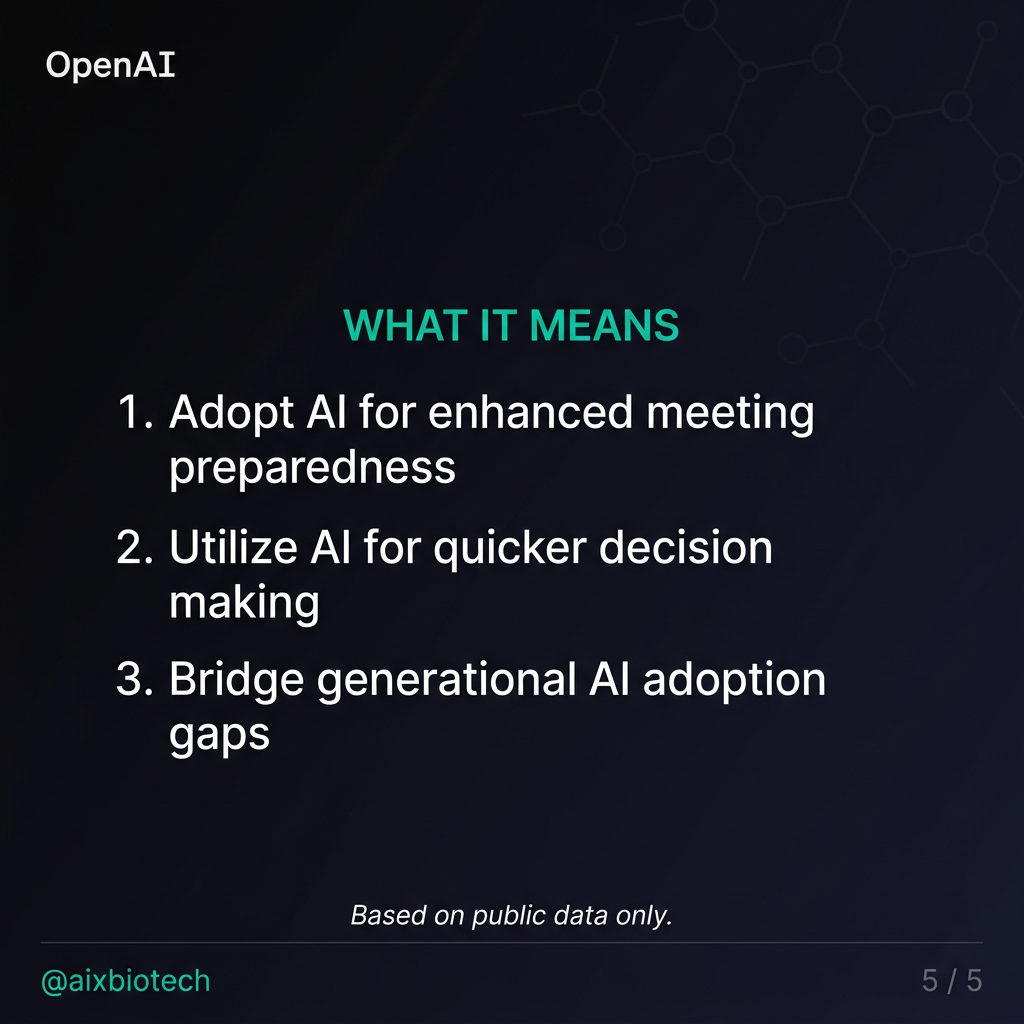
Fellow.ai’s 2025 meeting statistics report found that the average professional spends 69 minutes preparing for each meeting. Forty percent waste up to 30 minutes just getting oriented before a discussion starts. This is one of the most addressable inefficiencies in professional life, and AI handles it directly.
A personal AI assistant, set up with access to your documents, your calendar context, and your role priorities, can prepare a meeting brief in minutes. It can summarise the relevant background, flag the key decisions that need to be made, identify the questions most likely to come up, and draft your talking points. You walk in prepared. The colleague who is still scanning the email thread on their phone as they sit down does not.
This is not a marginal efficiency gain. In decision-heavy roles, in supply chain, market access, commercial, legal, and regulatory, preparation quality directly correlates with influence quality. The person who walks in knowing the numbers, the context, and their position is the person who shapes the outcome. AI makes that level of preparation accessible to anyone willing to build the habit.
The Generational Anxiety That Nobody Is Admitting
There is a conversation happening in private that rarely surfaces in team meetings or performance reviews. Mid-career and senior professionals, people with ten, fifteen, twenty years of hard-won experience, are watching younger colleagues move faster with AI tools and wondering whether their experience advantage is eroding.
The data makes the anxiety understandable. University of Phoenix’s 2025 Generative AI Report found that younger workers are ten percentage points more confident using AI than Baby Boomers. Gen Z AI adoption at work sits at 82%, compared to 52% for Baby Boomers, according to Protiviti and London School of Economics research published in October 2025. The speed differential is real.
But the conclusion that experience is becoming less valuable is wrong. The University of Sydney published research in August 2025 specifically addressing this. Mid-career and senior workers have a structural advantage in AI use that younger colleagues do not. Decades of domain knowledge, stakeholder context, and critical thinking are exactly what turns a mediocre AI output into a precise, credible, high-quality result. A junior analyst with AI can generate a lot of content quickly. A senior professional with AI and twenty years of context can generate the right content, framed correctly, for the right audience, in a fraction of the time.
The risk for experienced professionals is not that younger colleagues will outperform them because of AI. The risk is choosing not to engage with AI and allowing a real speed gap to develop that experience alone cannot fully compensate for. The tools are not complicated. The barrier is almost entirely psychological.
AI as a Career Acceleration Tool
For professionals who want to move faster in their careers, AI is one of the most underused leverage points available right now. Forbes reported in July 2025 that 77% of managers who use AI tools rely on them when making promotion decisions about direct reports. That is not just AI changing how work gets done. It is AI changing who gets ahead.
Amazon and other large organisations have already begun factoring AI proficiency into career development frameworks. WorldatWork reported in 2025 that a growing number of organisations are exploring AI capability as a component of promotion criteria. The direction of travel is clear.
But the more immediate advantage is simpler. The professional who consistently delivers better-prepared work, stronger analysis, faster responses, and more considered recommendations stands out. Not because they are working harder. Because they are working with better tools, used deliberately. AI gives individuals the capacity to operate above their pay grade, not occasionally, but consistently. That is exactly what career advancement requires.
The Personal AI Assistant Setup That Changes the Equation
The professionals gaining the most from AI are not waiting for their company’s IT department to approve the right tool. They have built a personal setup at home that they use to prepare for work, develop their thinking, and stay ahead of their field. This involves no company data and no breach of corporate policy. It is about using AI on publicly available information, personal notes, and professional development tasks to show up sharper at work.
A practical personal setup in 2026 looks like this. A subscription to ChatGPT Plus, Claude Pro, or Gemini Advanced costs between $20 and $25 per month. Used consistently, this becomes the tool for reading and summarising long reports, preparing for complex meetings, researching topics before presenting on them, drafting communications, and thinking through strategic decisions. Not with company data. With public information and personal context.
The return on that monthly cost is not modest. Five hours of reclaimed preparation time per week, over 52 weeks, is 260 hours per year. The professional who uses those hours well does not just work more efficiently. They build compounding advantages in knowledge, preparation quality, and decision-making speed that peers without the habit cannot easily replicate.
What Genuine AI Fluency Looks Like in a Pharma or Biotech Role
AI fluency in a regulated industry is not about knowing how the models work. It is about knowing how to use them effectively on the tasks that matter in your role, while maintaining the professional judgement to know when the output needs checking, challenging, or discarding.
For a market access director, it means using AI to summarise HTA guidance updates from five markets in fifteen minutes instead of half a day, and using the saved time to develop the strategic response. For a supply chain manager, it means drafting scenario analyses and risk assessments faster, and spending the remaining time on the commercial judgements that require human experience. For a regulatory affairs professional, it means using AI to scan competitor label changes and flag the relevant variances, not to replace the regulatory expertise required to act on them.
In every case, the human contribution is not diminished. It is elevated. AI handles the information processing. The professional applies the expertise. The output is better than either could produce alone.
For context on how AI is being applied across specific pharma and biotech functions, see how AI is closing the $356 billion distributor margin gap in biotech commercial operations and what AI adoption signals mean for biotech legal and BD strategy.
Key Takeaway
AI is not a corporate initiative to wait for. It is a personal capability to build now. The professionals pulling ahead in 2026 are the ones who have built daily habits around AI use, in their own time, with their own setup, applied to the work that matters. The entry cost is low. The compounding advantage is real. The question worth asking yourself honestly is not whether AI will change your industry. It already has. The question is whether you are using it.
Are you already using a personal AI assistant at home to prepare for work and stay ahead? Share in the comments.
Frequently Asked Questions
Do I need technical skills to build a personal AI assistant setup?
No. The most effective personal setups in 2026 require nothing more than a paid subscription to a consumer AI platform such as ChatGPT Plus, Claude Pro, or Gemini Advanced. No coding, no IT setup, no integration required. The learning curve is measured in hours, not weeks. The primary investment is in building consistent daily habits around use.
Is it safe to use personal AI tools for work preparation?
Personal AI tools are appropriate for publicly available information, your own thinking and notes, and professional development tasks that do not involve company data. Patient data, clinical trial information, regulatory submissions, unpublished compound data, and any proprietary or confidential company information must never be entered into a consumer AI tool. The productivity gains described in this article apply entirely to the safe side of that boundary.
Will AI make experienced professionals less valuable?
The evidence suggests the opposite when experienced professionals engage with the tools. University of Sydney research published in August 2025 found that mid-career and senior workers have a structural advantage in AI use because of their domain knowledge and critical thinking capabilities. The risk is not irrelevance. The risk is choosing not to engage and allowing a preparation and speed gap to develop.
How much time can AI realistically save a professional each week?
OpenAI data from December 2025, published by Fortune in April 2026, found enterprise workers who use AI effectively recover close to an hour per day. SAP and Forbes research from 2025 found an average of 52 minutes per day, or approximately five hours per week. Professionals in document-heavy or analysis-intensive roles tend to see the largest gains.
Based on publicly available information. This analysis covers non-proprietary, publicly disclosed data only. Statistics referenced from published research by OpenAI, McKinsey, Forbes, SAP, Protiviti, the London School of Economics, Fellow.ai, and the University of Sydney.