
AI payer intelligence in biotech: how to stop guessing what reimbursement bodies want
Most biotech market access strategies are built on past HTA decisions and consultant intuition. That is a fragile foundation when payer bodies are changing their evidence requirements faster than most teams can track.
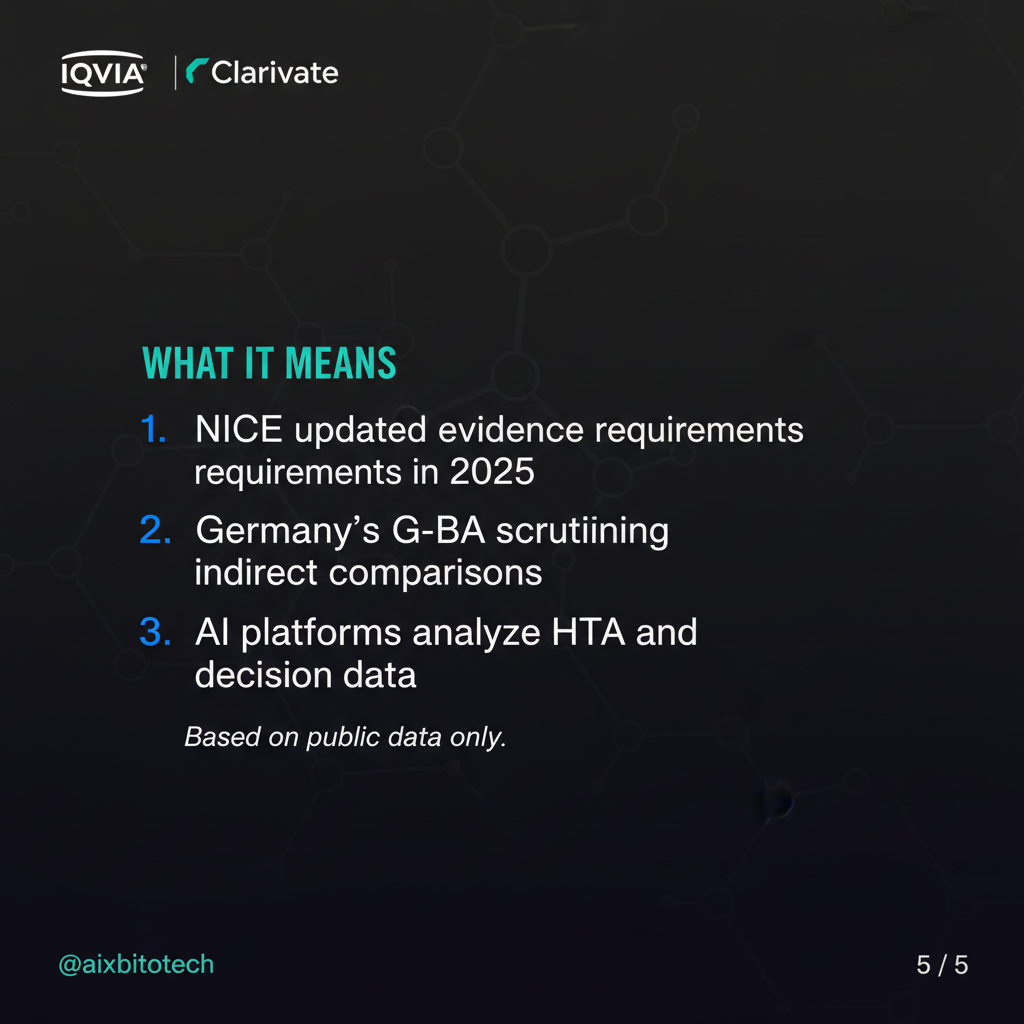
In 2025, the pace of regulatory and reimbursement guidance updates accelerated. NICE updated its methods guide. Germany’s G-BA increased scrutiny on indirect comparisons. The Gulf Health Council issued new AI-specific HTA guidance. Market access teams that were monitoring these changes in real time adapted their dossiers. Teams relying on annual consultancy updates did not.
What AI payer intelligence does
AI payer intelligence platforms pull together published HTA decisions, committee meeting minutes, payer communication patterns, health economics literature, and comparative effectiveness research to build a continuously updated picture of what each payer body is currently weighting in its decisions.
The output is not a static report. It is a live signal feed. When NICE’s independent evidence review committee begins questioning the robustness of certain patient-reported outcome instruments, the AI system flags it weeks before the formal guidance update is published. When G-BA begins consistently downgrading indirect comparisons in a specific indication, the system surfaces it as a pattern before it becomes a policy statement.
Key stat: In 2025, national pricing and reimbursement agencies in multiple markets issued targeted guidance on the role of AI-generated evidence in HTA submissions, signalling that the evidentiary bar for AI-assisted analyses is being actively redefined. Source: REMAP Consulting, 2025 Market Access Trends Report.
Tools market access teams are using
Kompass AI is one of the more purpose-built payer intelligence tools in the market. It indexes HTA decisions across major markets, tags evidence signals by type and weight, and tracks how specific evidence categories perform across different payer bodies over time.
IQVIA’s payer analytics tools provide a broader dataset with deeper integration into real-world evidence and comparative effectiveness research. They are more resource-intensive to deploy but give a more comprehensive picture for multi-market launches.
Clarivate’s Cortellis Market Access module provides decision-support for early asset assessment, helping BD and clinical development teams understand the payer landscape before Phase III design is finalised. Most teams engage market access thinking too late. This tool moves it earlier.
How to use payer intelligence to sharpen your dossier
The most actionable use of AI payer intelligence is in dossier design, not submission. By the time you are submitting, the evidence package is largely fixed. The leverage point is two to three years earlier, when clinical development decisions about endpoints, comparators, and subgroup analyses are still being made.
AI payer intelligence used at this stage can answer: which endpoints is NICE currently accepting for this indication? Which comparators is G-BA using as the appropriate comparator in similar products? What real-world evidence has supported reimbursement in analogous cases in the past 24 months?
Teams that answer these questions before Phase III design lock in are entering reimbursement negotiations with dossiers that are structurally aligned with current payer expectations, not historical ones.
Our analysis of AI price corridor modelling covers the pricing dimension of the same challenge. Payer intelligence and price corridor modelling should be run in parallel, not sequentially.
FAQ
Can AI payer intelligence replace a market access consultant?
No. AI payer intelligence provides data synthesis and pattern recognition at scale. It does not provide the relational intelligence, negotiation experience, or market-specific nuance that a good market access consultant brings. The two are complementary.
How current is the data in AI payer intelligence platforms?
The best platforms update continuously from public HTA decision databases, regulatory feeds, and academic literature. The platform is typically two to four weeks ahead of what a manual literature review would surface.
Is AI payer intelligence useful for rare disease products?
Yes, but with limitations. Rare disease HTA processes are inherently less precedent-driven. AI payer intelligence is most useful for identifying which payer bodies are actively developing rare disease HTA methodology and what signals they are sending about acceptable evidence levels.
The market access teams that will consistently outperform are not the ones with the best consultants alone. They are the ones that use data to know what payers want before they ask for it.
Based on publicly available information. This analysis covers non-proprietary, publicly disclosed data only.