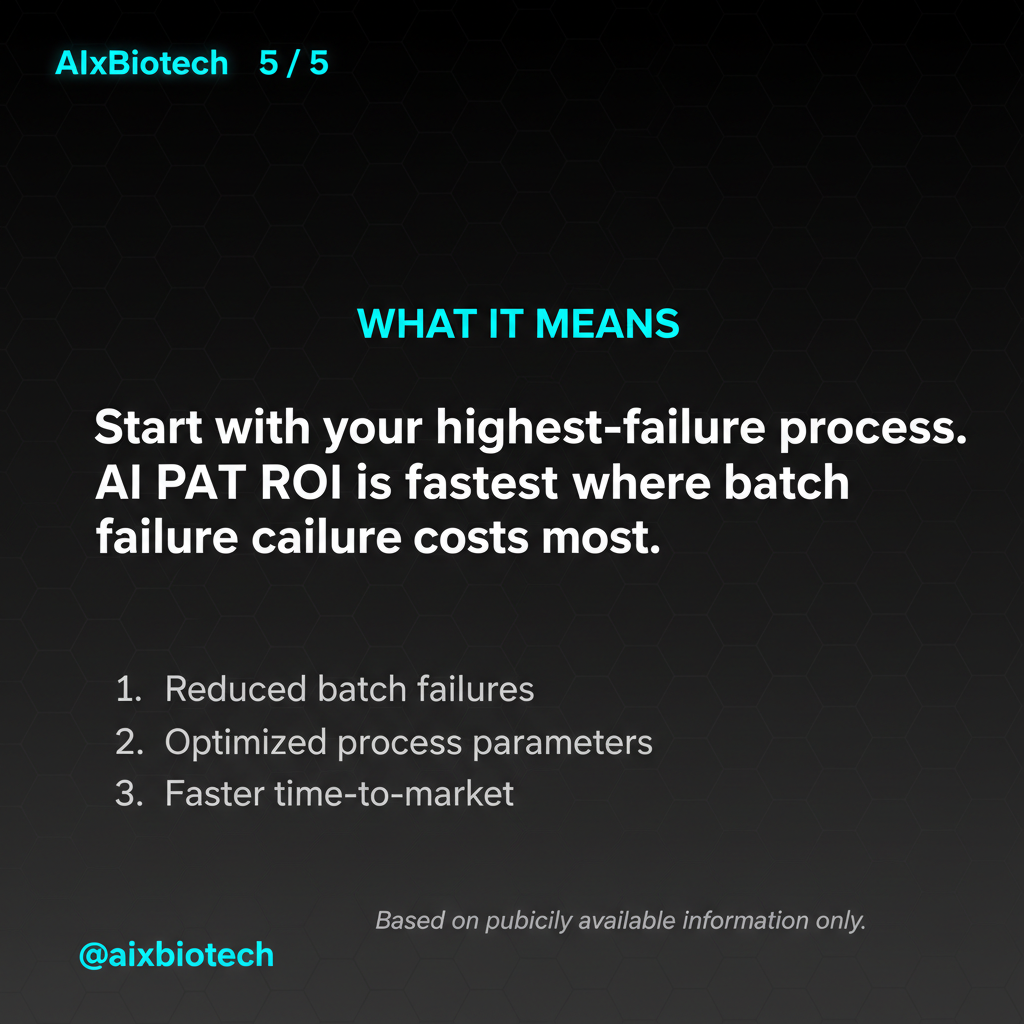

AI in pharmaceutical manufacturing quality: from reactive QC to predictive control
Pharmaceutical manufacturing quality control has operated on the same fundamental model for decades. Collect samples at defined intervals. Test in the laboratory. Release or reject the batch. Wait 48 to 72 hours for results.
AI is dismantling this model. Not incrementally. Structurally.
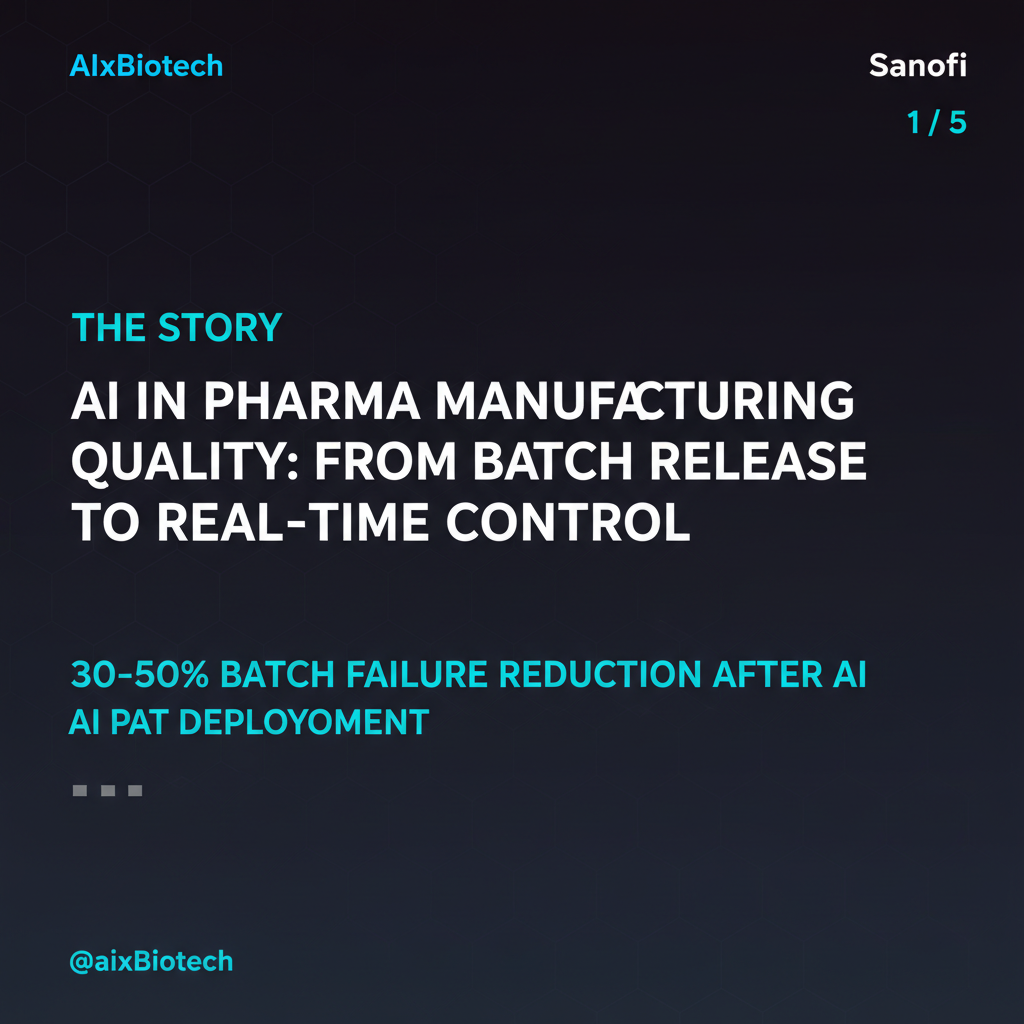
Sanofi’s CEO Paul Hudson described AI at the company’s manufacturing sites in February 2026 as “vital infrastructure,” not an experiment or a pilot programme. That language choice is significant. Infrastructure is what the rest of the business runs on. Experiments are optional. Infrastructure is not.
What AI quality control actually does
The core application is AI-powered Process Analytical Technology (PAT). PAT systems embed sensors directly into the manufacturing process to measure critical quality attributes in real time: particle size, moisture content, blend uniformity, dissolution rate, API concentration. The data feeds continuously into an AI model that monitors for deviations from the validated process corridor.
In a traditional QC model, a deviation is detected when the lab tests the sample that was collected hours ago. By then, the process has continued. Potentially compromised material has been produced. The batch investigation begins after the fact.
In an AI PAT model, the deviation is detected as it begins, while the process is still running. The system alerts the operator immediately. Corrective action can be taken in real time. In some systems, the AI makes automatic micro-adjustments to process parameters to bring the process back within specification without operator intervention.
Key stat: Leading manufacturers deploying AI PAT systems report batch failure rate reductions of 30 to 50% and release testing cycle time reductions of up to 50%. Source: Pharma Technology, How Pharma Is Preparing for 2026, January 2026.
The regulatory framework is already in place
One of the most common objections to AI in manufacturing quality is regulatory uncertainty. This objection no longer holds.
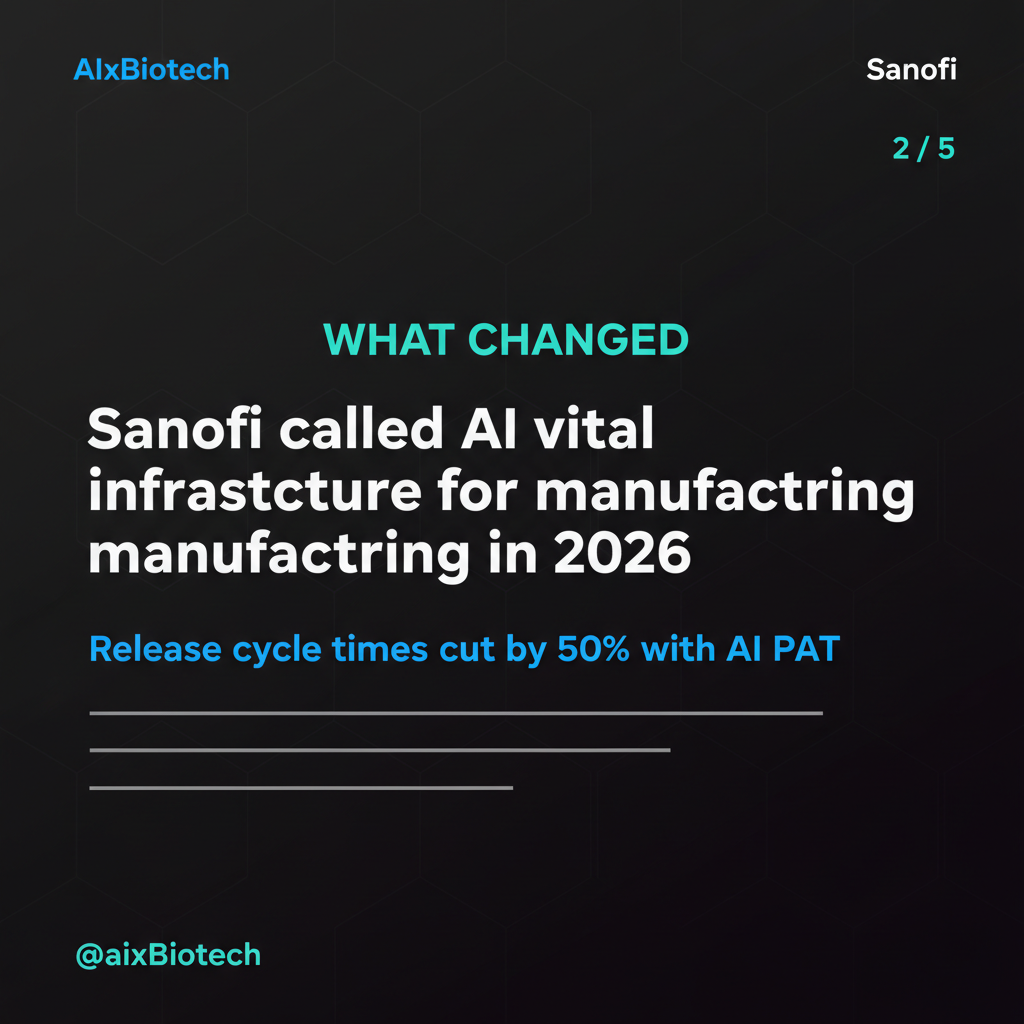
FDA published its PAT guidance in 2004. It explicitly supports the use of process analytical tools to monitor and control manufacturing in real time. FDA’s 2025 draft guidance on AI in drug development extended this framework to cover AI-assisted quality monitoring systems, specifying documentation requirements for AI tool validation and human oversight protocols.
ICH Q13 on continuous manufacturing was finalised in 2022 and adopted by both FDA and EMA. It provides the regulatory pathway for manufacturing processes that integrate real-time quality monitoring, including AI-driven control systems.
GxP requirements and 21 CFR Part 11 apply to any computerised system used in a regulated manufacturing environment, including AI quality systems. The validation burden is real. But the regulatory pathway is defined, not uncertain.
How leading manufacturers are deploying AI quality systems
Sanofi has deployed AI across its manufacturing network as part of a broader enterprise AI infrastructure programme. The company has been explicit that this is not a single-site pilot but a network-level deployment affecting multiple products and markets.
Novartis has deployed AI quality systems at its Stein site in Switzerland, one of its largest pharmaceutical manufacturing facilities. The system monitors over 200 critical quality parameters in real time across multiple production lines.
For biologics manufacturers, AI quality monitoring is particularly valuable given the complexity and variability of biological production processes. Cell culture monitoring, upstream bioprocess control, and downstream purification process optimisation are all areas where AI PAT is generating measurable yield and quality improvements.
Practical steps for a manufacturing quality team
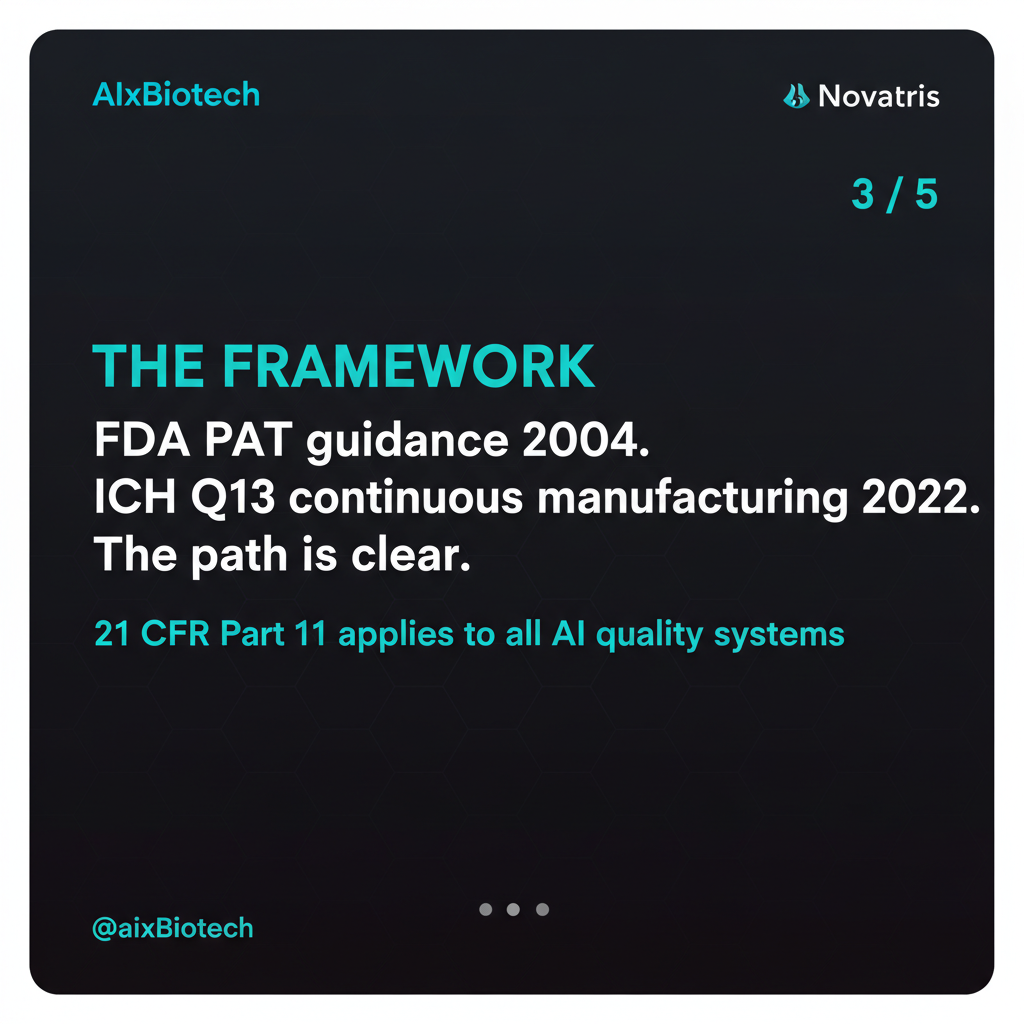
- Start with your highest-risk or highest-failure-rate process. AI quality systems deliver the fastest ROI where the cost of batch failure is highest. Identify your worst-performing process step and build the first AI monitoring application there.
- Connect your existing sensor data first. Most manufacturing sites have more sensor data than they are using. Before investing in new sensor infrastructure, assess whether your existing data streams are sufficient to build the first AI monitoring model.
- Validate for your specific process. AI quality models are process-specific. A model validated for one tablet compression line cannot be assumed to transfer to another without revalidation. Build your validation strategy from the outset, not as an afterthought.
- Define the human oversight protocol. FDA and EMA both require that AI-assisted quality decisions in regulated manufacturing have documented human review. Define the escalation pathway: when does the AI alert a human, and when does the human override the AI? This is a process design question, not just an IT question.
Our analysis of how AI is cutting supply chain costs across biotech covers the broader cost reduction framework. Manufacturing quality improvement is consistently the highest-ROI application within that broader programme.
FAQ
Does AI quality monitoring require replacing existing manufacturing execution systems?
No. AI quality monitoring layers on top of existing MES and SCADA systems via standard data integration. The AI model consumes data from existing systems; it does not replace them.
How do you handle AI quality monitoring during an FDA inspection?
The AI system, its validation documentation, and the human oversight protocol are part of your quality system documentation. Inspectors will review the validation records, the change control history, and the deviation records associated with the system. Prepare these as you would for any other computer system validation under 21 CFR Part 11.
What is a realistic timeline from decision to deployment?
For a single process step at a single site, a realistic timeline from decision to validated deployment is 12 to 18 months. Network-level deployment across multiple sites takes two to four years depending on the complexity of the manufacturing network.
The manufacturers building AI quality infrastructure now are building a compounding operational advantage. Every year of AI-monitored production generates more training data. Better training data means better models. Better models mean better quality outcomes and lower costs. The advantage is structural, not temporary.
Based on publicly available information. This analysis covers non-proprietary, publicly disclosed data only.